Concerns about proposed Downtown Development Authority
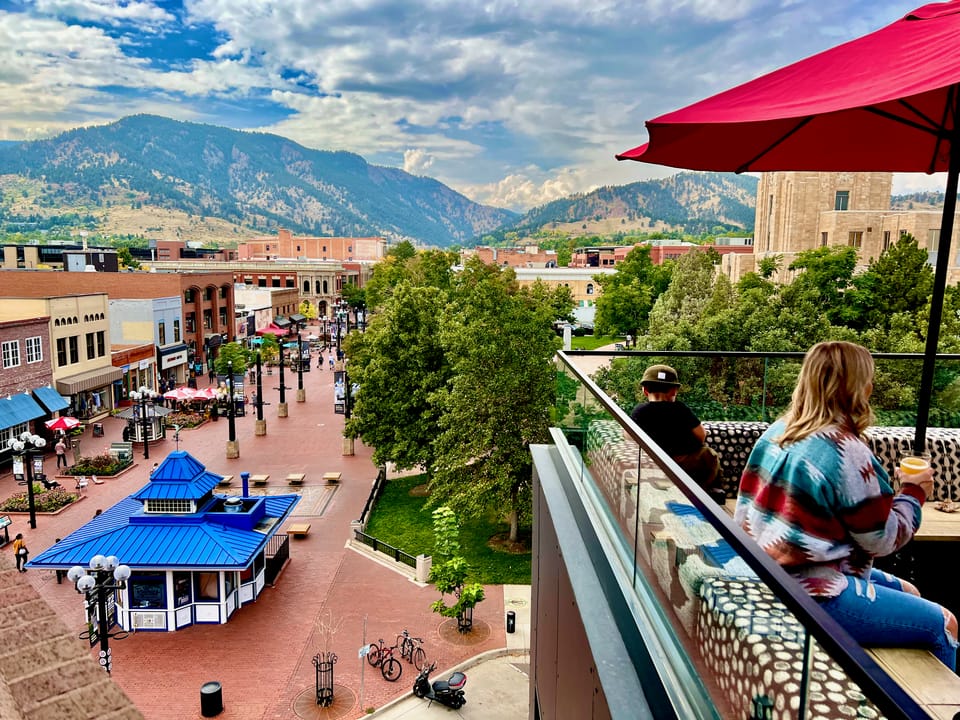
The Boulder City Council is considering creating a Downtown Development Authority (DDA), a new semi-independent governmental entity that would oversee economic development and reinvestment in downtown Boulder and University Hill for an initial 30-year period, with options for two 20-year extensions. The DDA would be funded through tax increment financing (TIF), which captures growth in tax revenues above a base year within the district boundary.
Top concerns at a glance
- The intergovernmental agreement (IGA), the document needed to protect city, school district, and library district revenue, will not be drafted before Council votes in August, or even before the November election.
- TIF locks up 30 years of downtown revenue growth with no return to the city's general fund, transportation fund, or other citywide priorities.
- The parking garage transfer puts EcoPass funding and parking pricing policy in the hands of a board with no Transportation Department role and no binding commitment to multimodal goals.
- This 30-year decision rests with roughly 2,500 voters within the district, not the city as a whole, and non-resident owners of multiple LLCs can cast multiple votes.
For property tax TIF, staff has stated that only new-investment-driven growth would go to the DDA, with natural appreciation continuing to flow to existing taxing entities — though this protection is contingent on revenue sharing provisions in the intergovernmental agreement (IGA), which has not yet been drafted. For sales tax TIF, all growth above the base year goes to the DDA with no equivalent carve-out.
Additional funding would come from a new mill levy (3.674 mills) assessed annually on current property values within the district, separate from TIF. This replaces the existing Central Area General Improvement District (CAGID) mill levy at about the same rate, represents a slight increase for University Hill General Improvement District (UHGID) properties, and is a new tax for properties newly included in the DDA boundary that were not previously part of either GID. Further funding would potentially come from the transfer of the city's downtown parking garages and lots from CAGID and UHGID to the DDA.
Council is expected to decide in August whether to place the measure on the November 2026 ballot. If it does, only the approximately 2,500 property owners, residents, and lessees within the district boundary would be eligible to vote.
Boulder Progressives is strongly supportive of the economic and social health and success of the downtown as truly the beating heart of our city, and home to our most beloved public space, the Pearl Street Mall. However, we are concerned about the structure and implications of the DDA as currently proposed. The following details our concerns.
Fiscal concerns
- Sales tax TIF, which has no carve-out for natural growth, diverts all growth above the base year away from the city's general fund, Transportation fund, Open Space fund, and Parks fund for 30 years, and is projected to generate between $3.5 million and $11.5 million over just the first six years, making it the larger and more certain near-term fiscal impact. TIF is generally considered an appropriate tool for creating new value in underdeveloped areas such as transit station redevelopment, but raises more serious concerns when applied to a largely built-out commercial district where the increment reflects existing economic activity rather than genuinely new investment.
- The justification for TIF rests on the premise that DDA investment causes the captured revenue growth, but there is no mechanism to distinguish DDA-driven growth from growth caused by other factors. The TIF base year will be set during a period of economic downturn, using depressed 2026 revenues as the baseline; post-recession periods historically generate strong recovery growth, which would be captured by the DDA as if it were the result of DDA investment. The arrival of the Sundance Film Festival in January 2027 is expected to increase downtown sales tax revenue independent of any DDA activity. And because the base year figures appear to be fixed in nominal dollars, even purely inflation-driven revenue growth would flow entirely to the DDA while the city's base revenue erodes in real terms.
- Property tax TIF has the potential to divert revenue growth away not only from the city but also from the Boulder Valley School District and the Boulder Public Library District, both funded through property tax mill levies on properties within the DDA boundary.
- Parking revenues are projected at roughly $44 million over the first six years. The staff packet's own language acknowledges that the mill levy and parking assets are "essential for near-term capacity and investments," meaning the parking asset transfer is structurally load-bearing for the DDA, not incidental to it.
- The proposal transfers ownership of the parking garage structures and the land beneath them, among the most valuable real estate in the city, from the city to a semi-independent board dominated by business interests, with no mechanism requiring those assets to serve broader public goals. This represents a permanent and largely irreversible loss of public flexibility, and the staff packet itself contemplates that the DDA could eventually sell individual garages to private developers, with the city receiving no compensation for either the initial transfer or any subsequent sale.
- Council and others have rightfully expressed concern about Boulder’s over-reliance on dedicated revenue sources, which diminish the city’s fiscal resilience and lock in past priorities regardless of how community needs evolve. The DDA is, in effect, a geographically-based dedicated revenue system that compounds this problem: revenue captured for 30 years would not be available for other citywide priorities, such as replacing the South Boulder Recreation Center or funding wildfire mitigation and disaster recovery, no matter how urgent or broadly supported.
Governance concerns
- The electorate is limited to roughly 2,500 property owners, residents, and lessees within the district boundary. The vast majority of Boulder residents have no vote on a 30-year commitment of public assets and tax revenues. Individuals who own multiple LLCs within the DDA would be allotted multiple votes, even if they live out of state.
- State statute requires a majority of DDA board members to be property owners, residents, or business operators within the district, structurally orienting the board toward downtown business interests regardless of who makes appointments. Property owners who serve on the board are not required to live in Boulder or even in Colorado, meaning a majority of the board could be composed of individuals with a financial stake in the district but no broader stake in the city as a whole.
- The candidate pipeline for the initial board runs through the same Planning Working Group that designed the proposal, with no apparent role for city boards and commissions or community organizations outside the district.
- City Council retains only annual budget approval and board appointments as oversight tools, both blunt instruments poorly suited to influencing day-to-day decisions on parking pricing, EcoPass funding, or mobility investments.
- In 2025, the Denver DDA spent approximately $68 million in TIF funds to purchase the struggling Denver Pavilions mall and adjacent parking lots, when the property was at risk of lender foreclosure, costing the city and Denver Public Schools property tax revenue as a tax-exempt entity. A subsequent Urban Land Institute panel recommended demolishing most of the mall. The episode illustrates how a DDA with significant TIF resources can make major real estate decisions that may not align with broader community priorities, with limited mechanisms for public accountability.
Transportation and EcoPass concerns
- Parking pricing and operational authority over the off-street parking system, including downtown and University Hill garages and lots, would move to the DDA board, whose mandate is district economic vitality rather than Transportation Master Plan or BVCP goals, with no Transportation and Mobility Department seat in the governance structure to counterbalance that. This risks undermining Boulder's decade-plus of parking reform, built on the understanding that parking pricing shapes transportation behavior across the whole city, in favor of a board optimizing for business convenience.
- Transportation-related commitments in the proposal are aspirational rather than binding. EcoPass funding for downtown and University Hill employees was an explicit part of the original charters of both CAGID and UHGID, but the DDA documents make no mention of EcoPasses, leaving their continuity entirely unaddressed as both GIDs are wound down. Mobility hub language in the Plan of Development is similarly aspirational, appearing as one item on a menu of options with no binding commitment or performance metric in the governance framework.
Process concerns
- The proposal is on a fast track for an August Council decision on ballot referral, with the IGA not yet drafted and key details unresolved.
- Boards and commissions with expertise, including the Planning Board and Transportation Advisory Board, have had no formal opportunity to review or comment on the proposal before the August decision point.
- The staff packet presents two funding scenarios, with and without parking assets, but only develops the parking-included scenario with detailed financial projections and an implementation framework. Without an equally rigorous analysis of the alternative, Council and the public cannot make a genuine comparison, and the parking-included option is effectively framed as the only viable choice before Council has formally weighed in.
- Results from the city's Fund Our Future survey and community engagement effort are expected to be presented at a June City Council meeting. Community priorities identified through that process span the entire city and are unlikely to place downtown revitalization at the top of the list. The proposed DDA would lock in preferential allocation of downtown tax revenues for 30 years regardless of how broader community priorities evolve over that period.
As noted above, we strongly support the downtown and want it to be a thriving part of the city that brings benefits for all Boulderites. However, we feel the DDA as proposed is not the best mechanism to promote both the success of the downtown and the interests of the broader community. We therefore request that City Council not approve the proposal as currently structured, and instead direct staff to research other ways to benefit the downtown while addressing the concerns above.